Same But… (Part 2)
The Return to Cold War Dynamics

This text follows my previous text, in which I raised concerns about the gradual installation of certain dynamics in the way Lithuania-and more broadly “the Baltic” region-is represented in France. At the time (in January 2026), these shifts were still perceived by some as isolated gestures, imprecisions, or curatorial choices.
This is, therefore, an update.
What once appeared as scattered signs is beginning to take on coherence. Language, programming choices, institutional networks, and cultural framing increasingly converge toward a familiar pattern-one that recalls, in unsettling ways, the representational logic of the Cold War.
The title Same But… reflects precisely this ambiguity. Nothing is entirely identical, and yet the underlying mechanisms feel strikingly similar. The vocabulary is slightly adjusted, the contexts are contemporary, the actors sometimes different-but the structure remains: a reframing of histories through categories that dilute, displace, or reassign their meaning.
This reflection was prompted by an event to which I received an invitation, indirectly. This detail is not incidental. Where information about Lithuanian cultural events once circulated openly, access now appears increasingly selective. Both the events themselves and their audiences are filtered through informal networks of affinity. Visibility is no longer shared; it is curated.
There are no longer Lithuanian cultural newsletters in France. When events are communicated, it is usually after they have already taken place, circulating within a limited circle through personal images on social media or via Instagram stories that disappear without a trace.
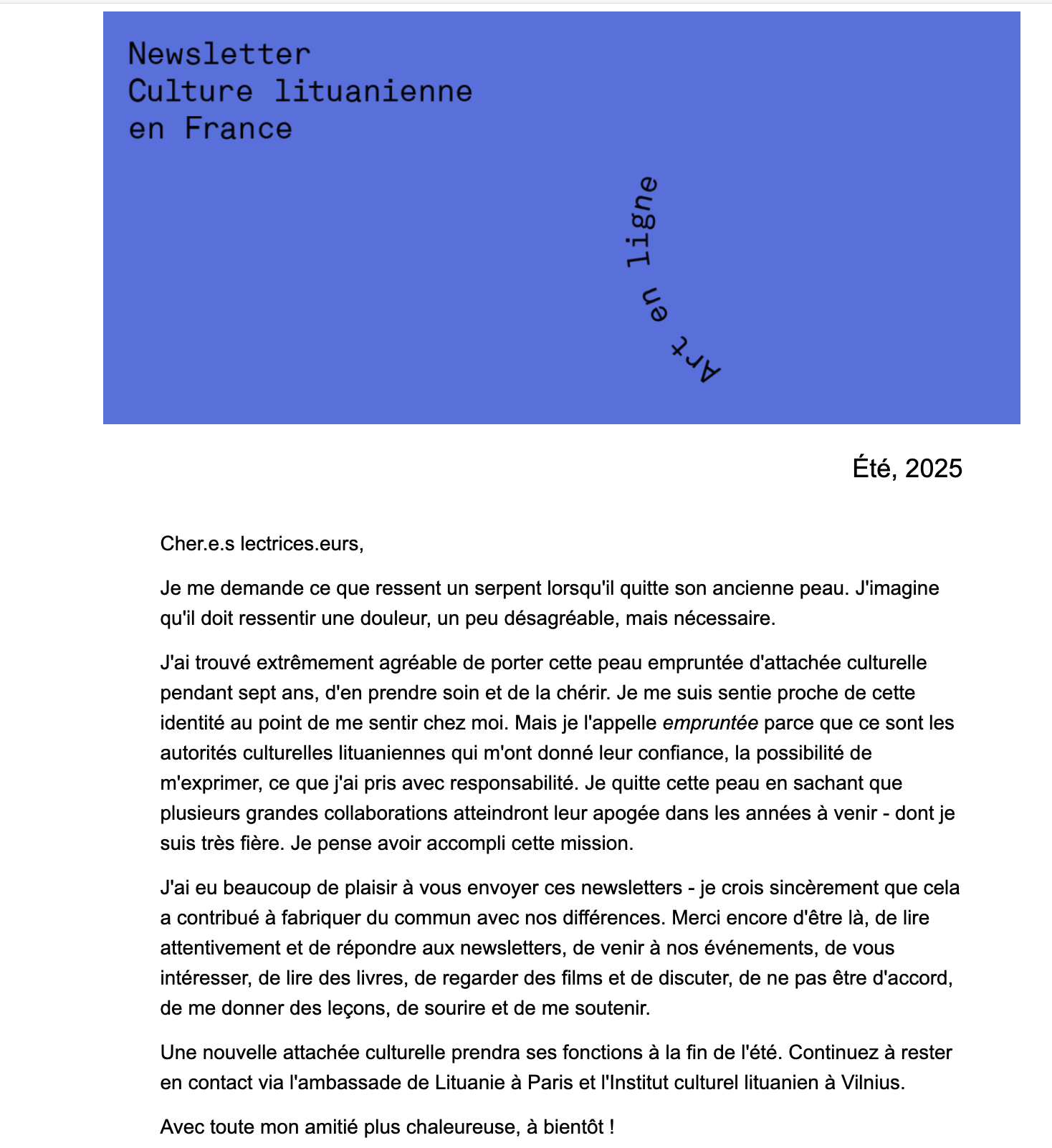
What concerns me here is not the question of access or attendance. For decades, Lithuanians developed a strategy of survival in which visibility was a form of power, carefully maintained, collectively constructed, and largely sustained by the diaspora.
As a historian, I rely heavily on this legacy. The archives of Lithuanian diaspora publications are among the most valuable sources we have. They were produced both in Lithuanian, as part of a coordinated effort to preserve identity, and in the languages of the countries where communities lived, allowing us to trace how Lithuania was represented abroad. Through them, it is possible to reconstruct not only events, but intentions, networks, and strategies.
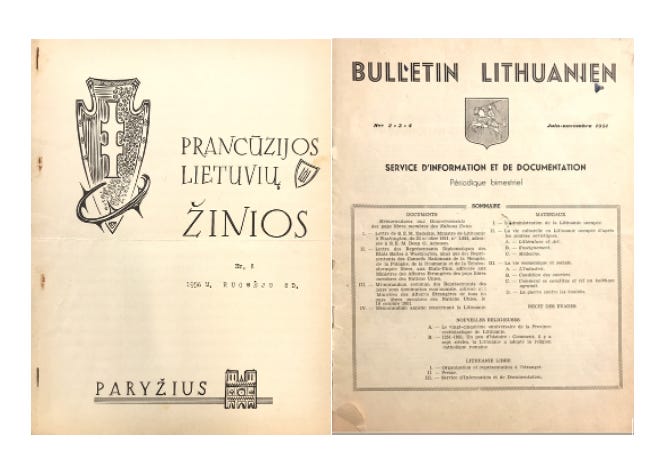
And yet today, in a context where Lithuania is free, this logic appears to be eroding. When communication becomes selective, ephemeral, and reduced to disappearing formats rather than documented. The trace disappears. For future historians, this absence will matter.
This is why I feel a responsibility to write.
Those shifts reflect a broader change in cultural policy discourse within Lithuania. As Matas Drukteinis, the Lithuanian Vice Minister of Culture, stated, it is “natural” for a director to choose with whom they would like to work.
Framed this way, personal preference is elevated above public responsibility and professional competence. It reflects a broader tendency to forget that public representatives are funded by taxpayers to serve the public interest, not to operate as private directors selecting collaborators based on individual affinity.
What may once have remained informal is now openly justified, signaling a shift in which personal comfort risks taking precedence over the responsibilities inherent to publicly funded roles.
A similar logic appears in Lithuania’s cultural policy abroad. As a result, a large part of the Lithuanian diaspora is set aside. I can partly understand a degree of separation from diaspora initiatives, which often operate independently and contribute, freely and actively, to Lithuania’s cultural presence abroad. Yet this is precisely why the current dynamic is problematic: at times when state support has traditionally been relayed through embassies, these institutions now appear to function in a more isolated way, limiting rather than extending that connection.
Lithuanians abroad are not simply an audience meant to consume these events. Their role has historically been different. Lithuania’s own history demonstrates that there are no more effective amplifiers of its cultural presence than its diaspora. Until Lithuania develops a network of cultural institutes abroad comparable to those of countries like France, there is no more efficient way to ensure visibility than to rely on this existing, informal network.
To exclude them from circulation is strategically short-sighted.
This text does not aim to accuse individuals of wrongdoing. Rather, it points to the fact that everyone operates within a system that already exists and is sustained through collective participation. Each person may feel like a single drop, acting without consequence, yet it is precisely the accumulation of individual actions that gives the system its form and persistence. This has happened before, and history shows that the consequences can be severe.
But let’s talk about the upcoming event in question, which will take place on May 5, 2026, in Paris, where Gražuolė (The Beauty) by Arūnas Žebriūnas is scheduled to be screened. Just let me begin where I left off last time.
Rewriting History Through Language
During the Baltic Poetics event, I publicly pointed out that certain terms being used were drawn from Soviet-era vocabulary that had long since been abandoned. After Lithuania’s independence, these formulations were deliberately replaced once it was established that the country had not entered the Soviet Union voluntarily, despite what labels such as “Soviet republic” had implied. The historically grounded term “under occupation” was adopted instead.
My concern was that Lithuanian institutions are now reintroducing and legitimizing these earlier terms. I was not alone in raising this issue. Other historians also spoke out publicly, warning that such shifts contribute to an ongoing rewriting of Lithuanian, Latvian, and Estonian histories.
The institutional response was revealing. Publicly, there was no reaction. Privately, the explanation given was that such terminology had been “found in the archives,”. Yet this argument ignores a fundamental fact: those archives were produced during the period of Soviet occupation. To reproduce their terminology is to repeat the language of the occupying power.
At the same time, similar shifts can be observed in the digital sphere. Researchers have pointed to changes in how Estonia is described on platforms like Wikipedia, and I have verified that similar modifications affect Lithuania as well. Wikipedia itself is not a stable or fully reliable source, given its open and constantly editable nature. What is more concerning, however, is when this language is taken up and reproduced by official institutions.
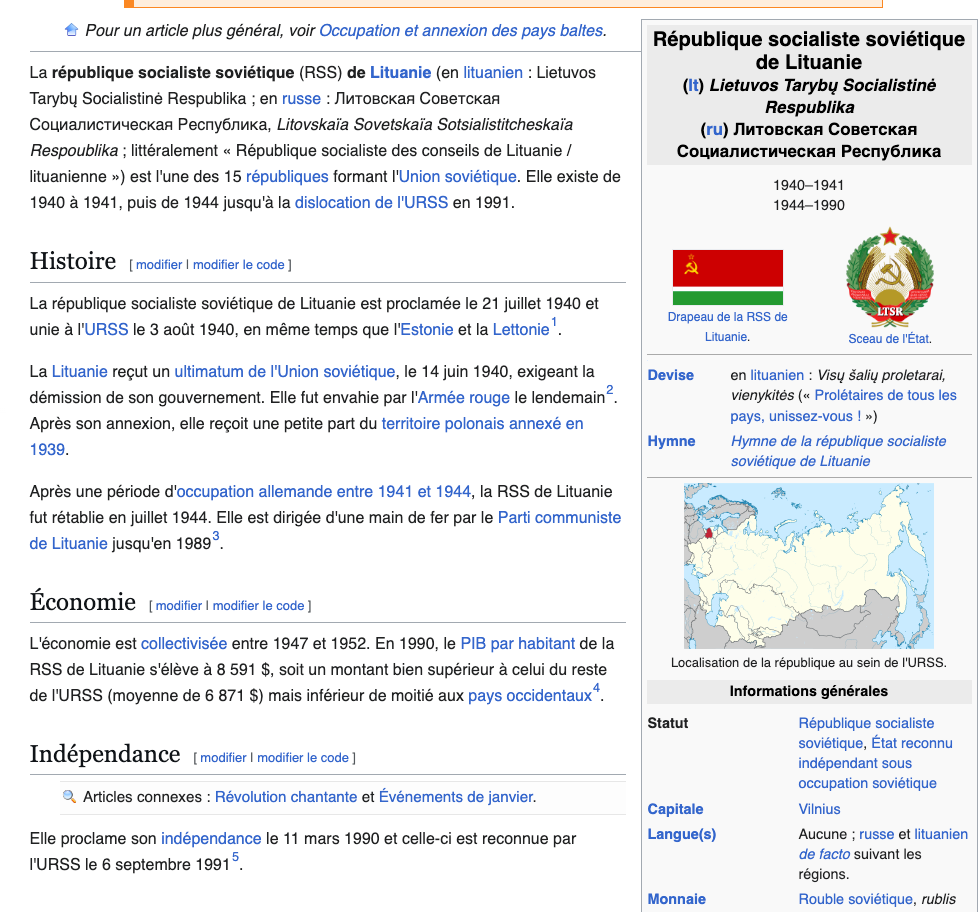
As reported by Le Monde, what is unfolding is not a series of isolated edits but a structured pattern that raises serious concern about the rewriting of history in the digital sphere. Investigations revealed that the birthplaces of hundreds of Estonian public figures were systematically modified on English-language Wikipedia pages, presenting them as born in the “Estonian Soviet Socialist Republic.”
Estonian journalist Ronald Liive, who uncovered the changes, described them as part of a broader attempt to reshape historical perception. Historian Robert Treufeldt warned that such modifications artificially associate Estonia with the Soviet Union and Russia, despite the official position that the state was illegally occupied and never ceased to exist.
The scale and nature of these changes suggest more than individual initiative. Researcher Valentin Châtelet notes that it is difficult “to see who is pulling the strings” in this specific case, but confirms that “Wikipedia is the nerve center of influence operations,” with Russia at the forefront. He further points to a large-scale ongoing operation known as “Pravda,” uncovered in 2025 with the Finnish company Check First, aimed at “information laundering” through the creation of “more than a hundred websites that are in fact fake news portals,” some of which are then used as sources to justify edits on Wikipedia.
What is particularly striking is the speed at which this dynamic moves from being identified to being reproduced. In January 2026, Le Monde reported on these practices as a source of concern. Yet within weeks, similar terminology began to appear in its own language. This shift is now visible across media and cultural discourse. It is especially alarming given the role of Le Monde as a reference publication, widely read by politicians, diplomats, academics, and the general public, and often used as a guide for how to write and formulate language. Terms such as “former Soviet Socialist Republic,” which had largely disappeared after the 1990s, are now reappearing even there.
When “Soviet” Means Russian and When It Does Not
The reappearance of terms such as “former Soviet” is not simply a matter of imprecision or habit. It reflects a deeper logic of selective association in which meaning is unevenly assigned.
For countries that were occupied, the historical effort since independence has been to clearly dissociate themselves from the Soviet Union and to reassert continuity of statehood. Yet this dissociation is not mirrored on the other side. Russia, as the central successor of the Soviet system, maintains a flexible relationship to that legacy, extending it both to culture and to the territories once under its control.
This produces a clear asymmetry. When elements from the Soviet period are seen as valuable, they are absorbed into a broader Russian narrative. Soviet becomes a proxy label through which Russia can continue to represent itself, especially in a context where direct identification as Russian is more difficult due to the current war. In this framework, cultural production from formerly occupied countries is also incorporated, allowing Russia to draw on and present these works as part of a shared, reassembled heritage.
In the event mentioned above, the film Gražuolė by Arūnas Žebriūnas is labeled “(USSR).” This designation does more than situate it historically. It effectively reassigns the work of a Lithuanian director to a broader Soviet label that functions here as a substitute for Russian cultural representation, while drawing on the cultural output of a country that was itself occupied.

Yet this framing ignores a fundamental fact. Žebriūnas was actively involved in the Sajūdis movement, the Lithuanian independence movement that led the country out of Soviet occupation. His position reflects a clear break with that system. Reassigning his work in this way contradicts both his political engagement and the historical reality it sought to overturn.
To understand how this logic operates in practice, it is necessary to examine the event itself.
Soviets, Childhood and Innocence
The screening mentioned above is not an isolated initiative. It forms part of a three-day international conference titled: “The Most Important of All Ages: Children, Childhood(s), and the Childlike in Soviet Cinema,” held from May 4 to May 6, 2026, across several Paris venues, including INHA, INALCO, La Fémis, Espace Saint-Michel, and the Cinéma Saint-André-des-Arts.
From the outset, the framing is explicit. Soviet cinema is approached through the lens of childhood, innocence, and universality. This association softens the historical reality of the Soviet system by placing it within an aesthetic register that distances it from its political context.
The event is organized in part by Université Paris 8, an institution often associated with radical left intellectual traditions in France. Its own institutional archives point to a historically complex relationship with the French Communist Party and the Soviet sphere. While some of its leadership explicitly distanced themselves from Soviet communism and even supported protests against Soviet actions, figures such as Irène Sokologorsky maintained close ties with the USSR and later Russia, while actively developing the university’s international relations.
This history does not indicate a simple alignment, but rather a longstanding engagement which continues to shape certain academic and cultural frameworks within the institution.
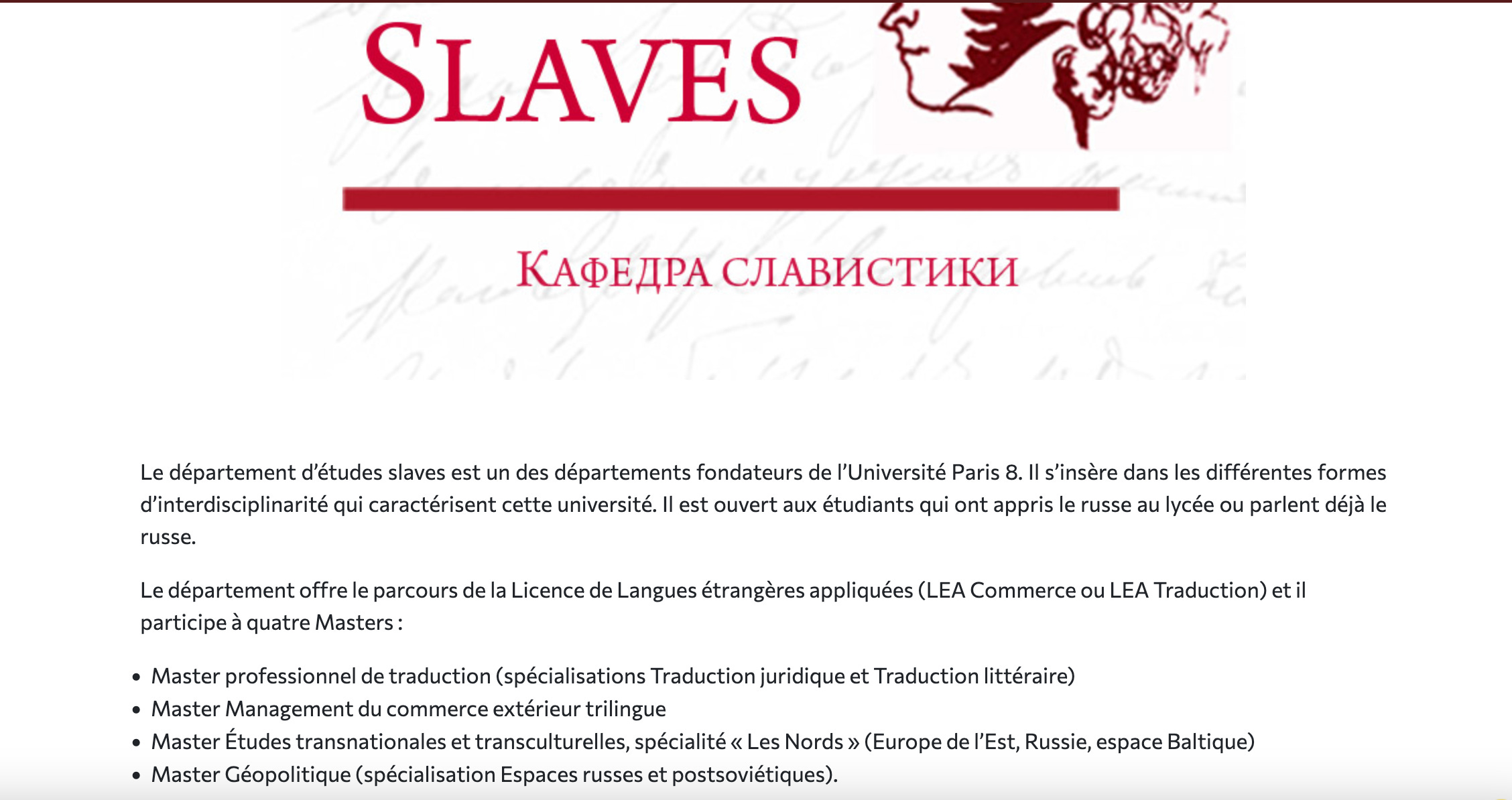
The profiles of those presenting the film form a coherent and acceptable combination.
Mathieu Lericq, a researcher at Université Paris 8 specializing in Central and Eastern European cinemas, represents the expected academic profile for such an event. Alongside him, Alantė Kavaitė, a Lithuanian filmmaker based in France who teaches at Paris 8, provides a direct Lithuanian presence, even if she is not a researcher.
At the same time, this is not new. Both Kavaitė and Irina Tcherneva, who appears in the scientific committee of the event, were already involved in the events discussed in my previous text.
One element, however, stands out. Despite the involvement of the same actors, the event was not announced, whereas in the case of Poétiques baltes it had been widely and openly circulated. As noted earlier, the promotion of Lithuanian cultural events through formal and collective channels has largely disappeared. When it does occur, it is typically associated with this same cinema and academic environment, where events are usually announced. In this case, however, such visibility is absent.
The Return of Familiar Logics
This environment warrants closer examination. While I did not fully develop its activities in my previous text, I will go further here by looking more closely at a company in which current Lithuanian cultural attaché was previously employed and which remains involved in the present event through the operation of one of its venues.
Shellac presents itself as a label active across several areas of cinema, including production, international sales, and film distribution in multiple forms. It also operates and programs cinema theaters, notably Le Gyptis and La Baleine in Marseille, as well as the Cinéma Saint-André-des-Arts in Paris.
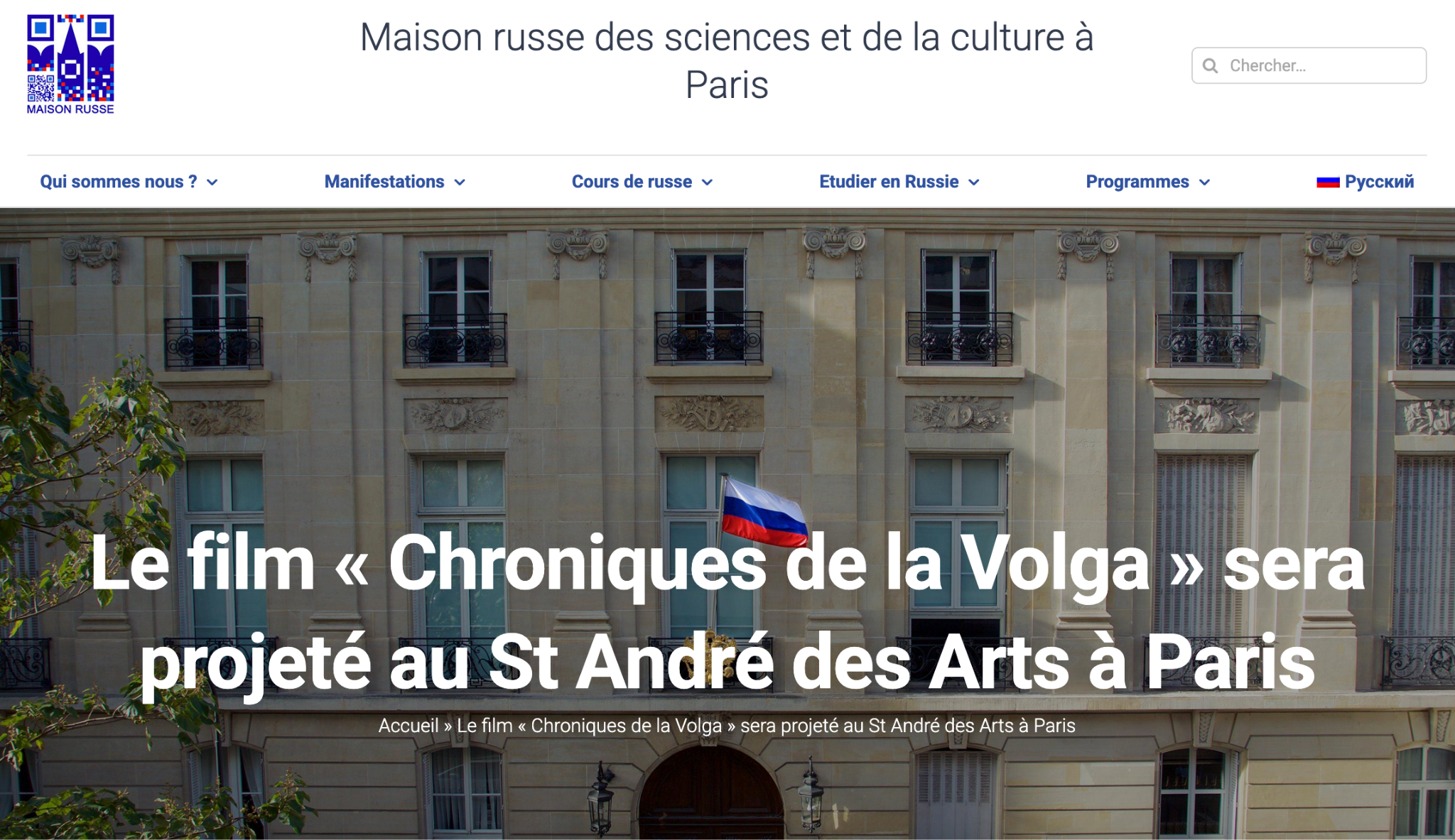
Within Lithuanian cinema circles, the company is known in particular for distributing films by Šarūnas Bartas, who has faced public accusations of serious misconduct during the #MeToo movement.
What is revealing, however, is not only this collaboration, but the way these films are presented.
In introducing his Au crépuscule (In the Dusk, 2020), a film about Lithuanian resistance against the Soviet regime, Shellac includes a contextual note, based on Bartas’s note of intention : “it is difficult to idealize this movement. Among the partisans, there were not only oppressed landowners and dissidents, but also former prisoners, spies, traitors, and Nazi collaborators hiding from the Soviets.”
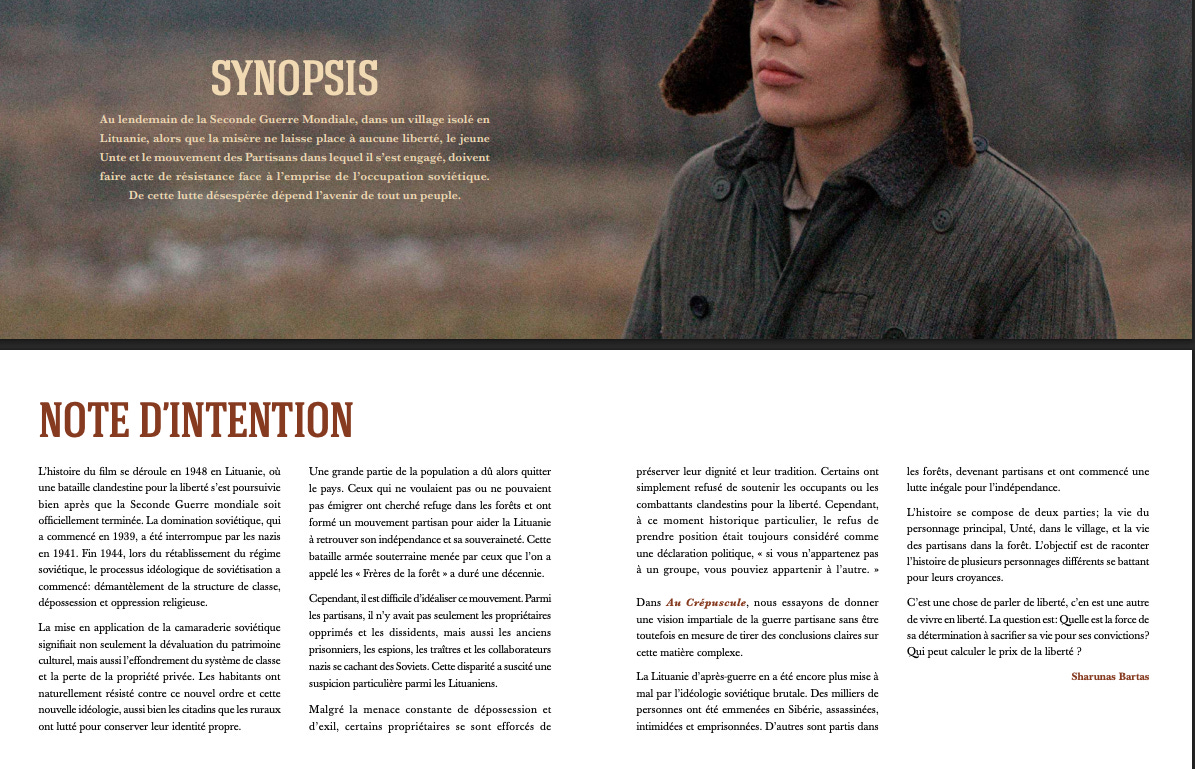
It is important to acknowledge that Lithuanian post-war resistance is a complex and, at times, uncomfortable subject. Like the history of the French Resistance, it was not composed of flawless figures, and it remains a legitimate field of inquiry for historians within each country. These are questions that must be examined internally, especially in a context of freedom.
However, when such narratives are framed and circulated abroad, they take on a different function. The tendency to delegitimize Lithuanian resistance is not new; it has a well-documented history.
During the Cold War, films such as Nobody Wanted to Die (1965) by Vytautas Žalakevičius were actively circulated internationally by Soviet authorities. The film was used as part of a broader strategy to shape Western perceptions, presenting Lithuanian partisans fighting Soviet power as morally questionable figures. By doing so, it shifted the focus away from the central issue, occupation, and redirected attention toward the supposed flaws of those resisting it.
At the same time, Shellac adopts a markedly different tone when presenting Russian subjects. In Imperial Princess (2024) by Virgil Vernier, the narrative shifts toward empathy, focusing on the personal isolation of a young woman affected by the consequences of sanctions against Russia for it’s agression: “Iulia lives alone in Monaco since her father’s departure, who returned to Russia because of the sanctions against his country. She no longer attends school. She feels increasingly alone and threatened.”
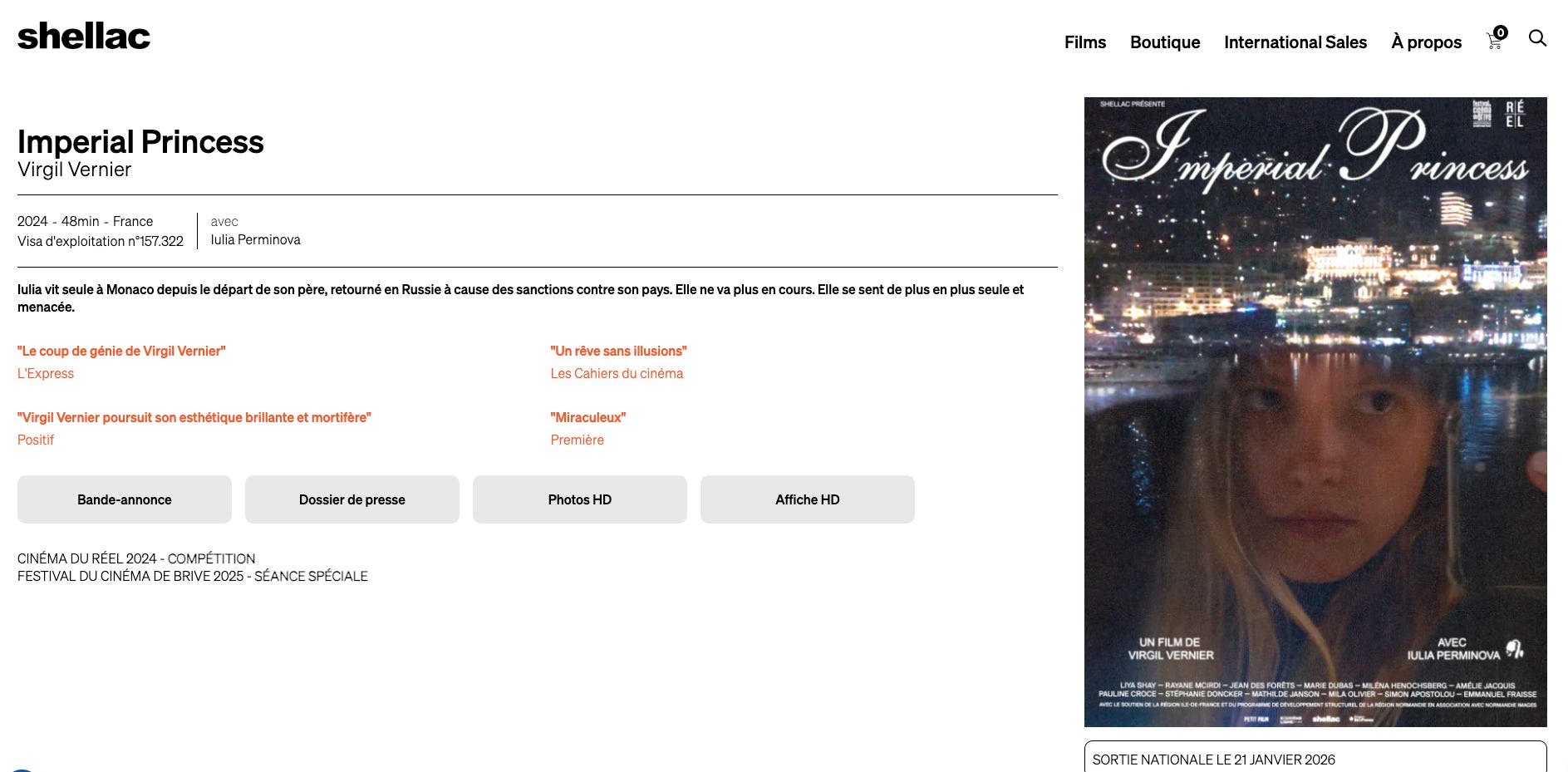
While Imperial Princess remained relatively limited in its reach, a similar narrative approach gained far broader visibility with Anora, directed by Sean Baker and produced and distributed within major international circuits. The film places Russian wealth and its social environment at the center of the story, following a young woman involved with the son of a Russian oligarch. Its international success, culminated in major awards.
What makes this problematic is not only the narrative itself, but how it is received and reused. As reported by Vanity Fair, the film’s success was quickly appropriated in Russia as a form of cultural validation. Russian media and pro-Kremlin commentators celebrated the recognition of actors such as Yura Borisov, presenting his international nomination as a national achievement. Borisov himself described the reaction in Russia as comparable to “a victory at the Olympic Games” .
Both films were produced in 2024. However, Imperial Princess was released at the same time (January 2026) as the events discussed in my earlier article, including Le Mage du Kremlin and Poétiques baltes. What emerges from this simultaneity is not a single message, but the convergence of several complementary narratives circulating within the same cultural moment.
First, with Poétiques baltes, Lithuania, Latvia, and Estonia are framed within a broader Russian or Soviet cultural space. Second, Le Mage du Kremlin contributes to a perception of Russian power as pervasive and difficult to counter, suggesting a form of inevitability. Third, films such as Imperial Princess or Anora foreground the vulnerability of individual Russian characters, shifting attention away from political responsibility and toward personal experience. In doing so, they promote a narrative in which distinctions are drawn between the Kremlin and “ordinary Russians,” a framing that can contribute to softening perceptions of responsibility and, indirectly, to questioning the legitimacy of sanctions.
What makes this imbalance particularly striking is that, unlike during the Cold War, we do not need years to learn what is happening. The contemporary context is visible, documented, and widely discussed. Russian power structures are not abstract or distant. They are present, active, and far from flawless.
My research on Lithuania’s image in France shows that this is exactly how Russian propaganda functions: not through overt statements, but through details of framing, vocabulary, and context.
These mechanisms, subtle as they look, proved sufficient over time to push Lithuania out of public view, until its situation no longer provoked attention or concern. This was made possible by a broader blindness to the gradual construction of an active propaganda apparatus, now firmly established and operating through constant, incremental steps, shaping perception with little resistance.
Update:
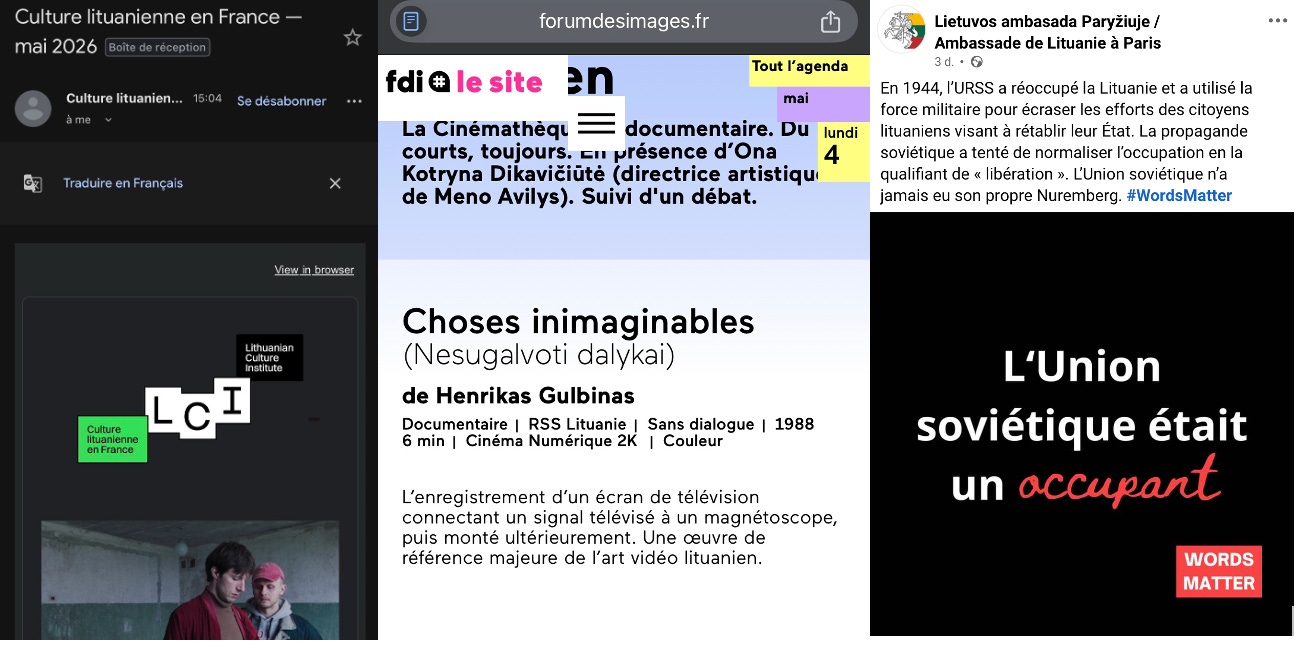
Just 6 hours and 54 minutes after publishing this text, I received the first newsletter since summer 2025, listing some Lithuanian cultural events taking place in May.
Through this newsletter, I got to know that the policy of referring to Lithuania as the “Lithuanian Soviet Socialist Republic” in promoted events has not changed. This stands in contrast with the Lithuanian Embassy in France publicly using the hashtag “#WordsMatter” just three days earlier.
I also learned that the event mentioned above, the screening of Žebriūnas’ film, is not included.